The Policy Agendas Project

Recommended works

29 studies of the same thing — attention, salience, agenda setting — built without Policy Agendas data. They are here because they are worth reading, and because they mark where the topic system could reach next: each entry says what it measures instead.

Research built on the data is on Impact.

01

The field

Newest first.

2025
Adjacent work

Spatial contagion and party competition on environmental issue salience

Luigi Curini, Luca Pinto — Electoral Studies

Argues that one party's emphasis on environmental issues spills over onto rivals, and finds this spatial contagion effect in manifesto and survey data, moderated by whether a green party competes.

Domain
Party manifestos
Data
Party emphasis on the environment in election manifestos, plus voter-side issue salience from surveys.
Time frame
not stated in the abstract
Electoral Studies ↗
2025
Adjacent work

How to train your stochastic parrot: large language models for political texts

Joseph T. Ornstein, Elise N. Blasingame, Jake S. Truscott — Political Science Research and Methods

Shows in pre-registered tests that few-shot prompting of large language models matches or beats supervised classifiers and approaches expert coding on several political-text measurement tasks, at much lower cost.

Data
The accuracy of few-shot LLM prompts on text-as-data tasks including topic assignment, scaling and sentiment.
Time frame
not stated in the abstract
Political Science Research and Methods ↗
2025
Adjacent work

Advancing Agenda Building Theory: Conceptualizing and Analyzing Processes Among Events, Publics, and Media in #StopAsianHate

Yini Zhang, Hyunyi Cho — Communication Research

Builds an agenda-building framework combining exogenous events, interpublic processes on social media and intermedia processes, then applies it to the #StopAsianHate movement using network and time-series analysis.

Domain
Social media
Data
Attention to anti-Asian hate across activist, allied-public and elite-media agendas on Twitter/X.
Time frame
not stated in the abstract
Communication Research ↗
2024
Adjacent work

Where do parties talk about what? Party issue salience across communication channels

Christoph Ivanusch — West European Politics

Trains a BERT classifier on labelled manifestos and transfers it to party press releases, speeches and tweets in Austria, Germany and Switzerland, showing that issue-salience strategies differ by communication channel.

Domain
Party manifestos
Data
Party issue salience separately in press releases, parliamentary speeches and tweets.
Time frame
not stated in the abstract
West European Politics ↗
2023
Adjacent work

The Global Resonance of Human Rights: What Google Trends Can Tell Us

Geoff Dancy, Christopher J. Fariss — American Political Science Review

Uses country-level Google search data to adjudicate between top-down and bottom-up accounts of where human-rights discourse resonates, finding interest concentrated in the Global South and strongest where repression persists.

Domain
Search interest
Data
Cross-national public interest in human rights, from aggregated Google search volume.
Time frame
not stated in the abstract
American Political Science Review ↗
2023
Adjacent work

Keyword‐Assisted Topic Models

Shusei Eshima, Kosuke Imai, Tomoya Sasaki — American Journal of Political Science

Shows that seeding a topic model with a few keywords per topic substantially improves its ability to recover concepts researchers actually care about, avoiding the duplicated and blended topics that plague unsupervised models.

Data
Topic prevalence in document collections, guided by a small set of researcher-supplied keywords per topic.
Time frame
not stated in the abstract
American Journal of Political Science ↗
2022
Adjacent work

Agenda‐setting under pressure: Does domestic politics influence the European Commission?

Christel Koop, Christine Reh, Edoardo Bressanelli — European Journal of Political Research

Asks whether politicisation reaches the EU's non-majoritarian institutions, and finds that the Commission's prioritisation of legislative proposals responds to domestic party, mass and electoral pressure.

Domain
Media
Data
Which legislative proposals the European Commission prioritises, against domestic issue salience and Euroscepticism.
Time frame
not stated in the abstract
European Journal of Political Research ↗
2021
Adjacent work

Cross-Domain Topic Classification for Political Texts

Moritz Osnabrügge, Elliott Ash, Massimo Morelli — Political Analysis

Introduces and evaluates supervised cross-domain topic classification, training on labelled party platforms and extrapolating topics to parliamentary speeches, and argues this is cheaper than within-domain supervision and more interpretable than unsupervised topic models.

Domain
Party manifestos
Data
Topic labels transferred from a labelled source corpus to an unlabelled target corpus in another domain.
Time frame
not stated in the abstract
Political Analysis ↗
2021
Adjacent work

Avoidance and engagement: Do societal problems fuel political parties’ issue attention?

Henrik Bech Seeberg — Party Politics

Argues that societal problems are a central source of issue engagement between competing parties, and shows that parties converge on the same issues when those issues are deteriorating in the real world.

Data
Whether parties engage with or avoid the issues rivals raise, and how far real-world problem indicators drive that engagement.
Time frame
not stated in the abstract
Party Politics ↗
2020
Adjacent work

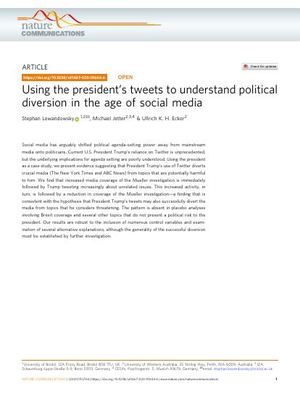
Using the president’s tweets to understand political diversion in the age of social media

Stephan Lewandowsky, Michael Jetter, Ullrich K. H. Ecker — Nature Communications

Finds that surges in coverage of the Mueller investigation were followed by the president tweeting more about unrelated issues, which was in turn followed by reduced coverage of the investigation, evidence of deliberate attention diversion.

Domain
Executive
Data
Topical composition of presidential tweets and of New York Times and ABC News coverage, day by day.
Time frame
not stated in the abstract
Nature Communications ↗
2020
Adjacent work

What’s the talk in Brussels? Leveraging daily news coverage to measure issue attention in the European Union

Michal Ovádek, Nicolas Lampach, Arthur Dyevre — European Union Politics

Proposes a new measure of EU issue attention built by text-mining the Agence Europe daily bulletin, arguing that existing EU salience measures are narrow in scope and reflect a single institution's priorities rather than the wider EU elite sphere.

Data
Daily EU-level issue attention, from the Agence Europe news bulletin.
Time frame
not stated in the abstract
European Union Politics ↗
2020
Adjacent work

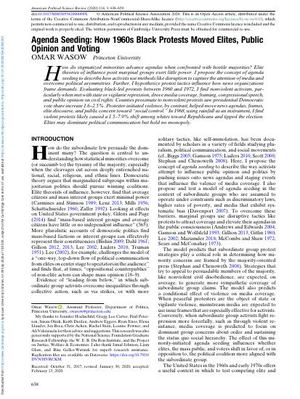
Agenda Seeding: How 1960s Black Protests Moved Elites, Public Opinion and Voting

Omar Wasow — American Political Science Review

Develops the concept of agenda seeding to explain how marginalised groups capture elite attention, and shows that nonviolent black-led protest met with repression drove news coverage, congressional speech and public opinion, while violent protest moved attention the other way.

Domain
Surveys
Data
Media coverage, media framing, congressional speech and public opinion on civil rights around 1960s protests.
Time frame
not stated in the abstract
American Political Science Review ↗