About the project
Three decades of measuring what American government pays attention to — one topic system, applied consistently from congressional hearings to front pages.


Directed from Syracuse University's Maxwell School, through the Campbell Public Affairs Institute, with the Department of Government at the University of Texas at Austin, the project's long-time home.
A short history
The books that built the field, and the empirical pattern they kept finding: policy attention does not drift, it lurches.
The punctuation signature
Annual percentage change in US budget authority, sixty programmatic subfunctions, FY1947–FY2003: a tall slender peak (most budgets barely move), weak shoulders (moderate adjustments are rarer than chance would predict) and heavy tails (a few leap). Leptokurtic and positively skewed — the empirical heart of punctuated-equilibrium theory. A schematic of the pattern reported by True, Jones and Baumgartner, “Punctuated-Equilibrium Theory: Explaining Stability and Change in Public Policymaking,” Figure 6.2, p. 170, in Paul A. Sabatier, ed., Theories of the Policy Process, 2nd ed. (Westview, 2007). The bar heights are illustrative, not the published counts. The dashed curve is a normal distribution drawn for contrast.
Baumgartner and Jones publish “Agenda Dynamics and Policy Subsystems” in the Journal of Politics, the article that names the two moving parts the project would go on to measure: the policy image (the set of beliefs attached to an issue), and the policy venue (the institution that acts on it). Their case is civilian nuclear power, and the evidence is congressional hearings coded for tone — favourable hearings falling away, critical hearings climbing from almost none to dominating the agenda. One process, they argue, explains both the decades of quiet and the sudden reversal.
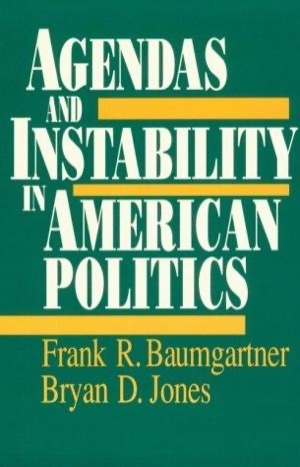
Frank Baumgartner and Bryan Jones publish Agendas and Instability in American Politics, the book whose agenda-setting research program the project would go on to extend. The project itself follows a year later.
Frank Baumgartner and Bryan Jones initiate the Policy Agendas Project, funded by the National Science Foundation as “Policy Agendas in the United States Since 1945” (SES-9320922, awarded March 1994) — a comprehensive database tracing public attention, media coverage, congressional attention, legislative action and budgetary outlays across the post-war period.
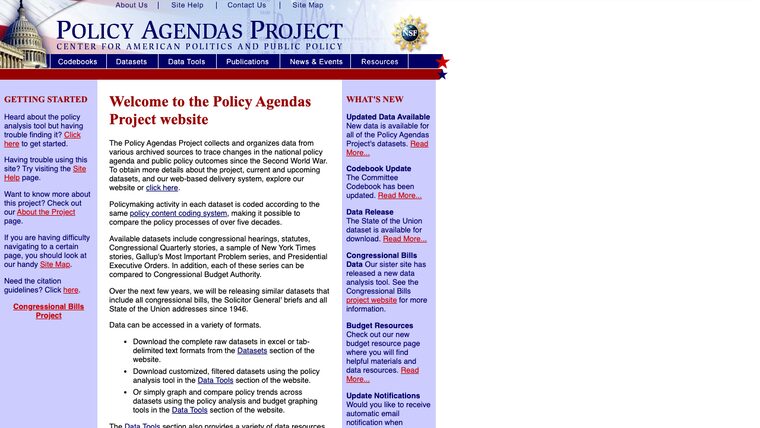
The project runs from the University of Washington (Jones, Wilkerson) and Penn State (Baumgartner), supported by the National Science Foundation (grant SES-0111443). The founders' analogy: do for public policy what the National Income Accounts do for the economy — consistent measurement over time.
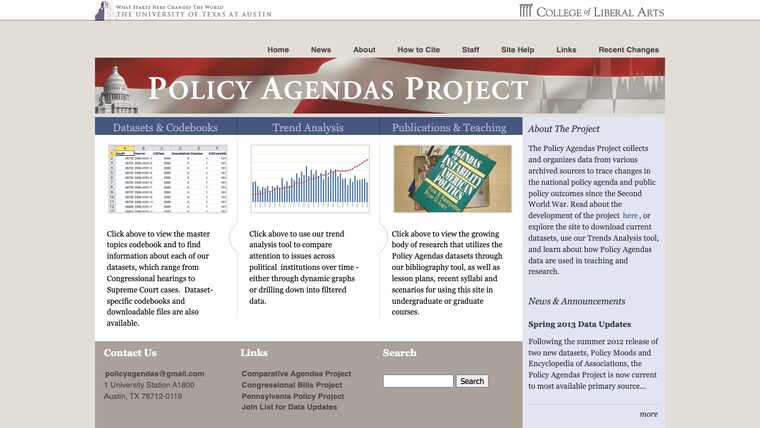
The project moves to the University of Texas at Austin's Department of Government. Around 2013 the national projects align their coding systems, producing the Comparative Agendas master codebook.
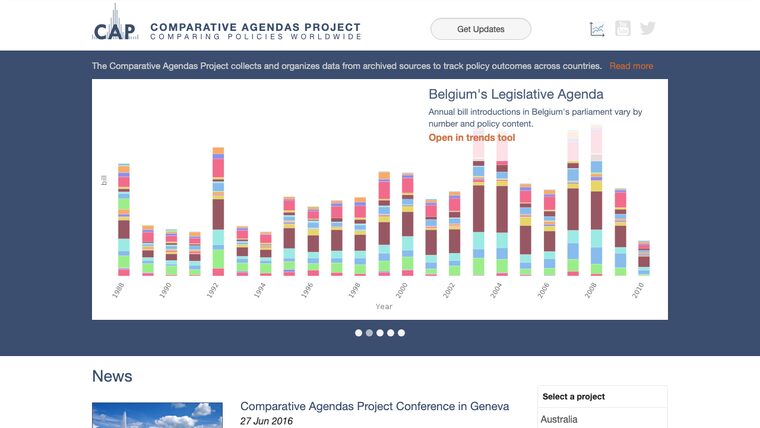
comparativeagendas.net launches as the shared home of the project family, replacing the old policyagendas.org. Today it hosts 20 established projects — 17 countries plus the EU, Florida, and Pennsylvania — with nine more in development.
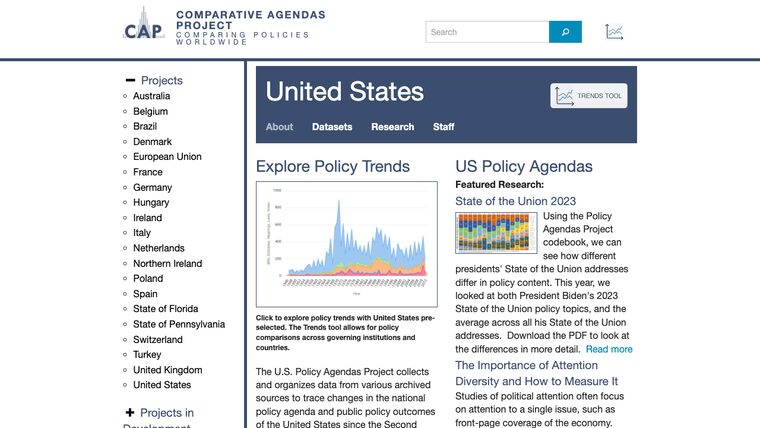
The US project — directed from Syracuse and Austin — maintains roughly 900,000 coded observations across its data series, tracing the national policy agenda since the Second World War. All data are free and public.
One codebook
Every observation is coded with the Comparative Agendas master codebook — described by the project as a “single, universal, and consistent coding scheme” — with 21 major policy topics and 220 subtopics, from Macroeconomics and Civil Rights to Defense and Government Operations. The original US codebook (19 major topics, 225 subtopics) is its direct ancestor.
The full major-topic list. Codes run to 23 but skip 11 and 22 — the numbering is inherited from the original US scheme and kept stable so decades of coded data stay comparable. Full codebook with subtopics ↗
The US data series
25 downloadable series, all free and public at comparativeagendas.net ↗. This site's new data sets will extend the same topic system to continuous media, social-group, and public-attention measurement.
Congressional Quarterly Almanac (1948–2015) · New York Times Front Page (1996–2006) · New York Times Index sample (1946–2016) · NYT Index Weights · Policy Frames Codebook · TV News Policy Agenda Data (1968–2010)
Congressional Bills (1947–2012) · Congressional Hearings (1946–2021) · Congressional Research Service Reports (1997–2021) · Public Laws (1948–2022) · Public Law Titles · Roll Call Votes (1947–2024)
Executive Orders (1945–2025) · Presidential Veto Rhetoric (1985–2016) · State of the Union Speeches (1946–2025)
Democratic Party Platform · Republican Party Platform (both quasi-statement coded, 1948–2024)
Supreme Court Cases (from 1901)
Budget Authority, adjusted (1947–2017) · Budget Authority–Policy Crosswalk · Budget Outlays (1791–2015) · Tax Expenditures (1979–2016)
Gallup's Most Important Problem (1947–2023) · Policy Moods (1940–2018) · Encyclopedia of Associations (1966–2001)
Facts and rosters on this page: comparativeagendas.net (the US project, master codebook, and About pages) and archived snapshots of the original policyagendas.org (2006, 2013), retrieved August 2026.
Contact
Questions about the data, the codebook, or using any of it in your own work are welcome.
uspolicyagendas@syr.edu — the US Policy Agendas Project's address, and the right first stop for anything about the archival data series.
Directed from Syracuse University's Maxwell School through the Campbell Public Affairs Institute ↗, with the Department of Government ↗ at the University of Texas at Austin. The people behind it are listed on the team page.
The long-run US series — hearings, bills, budgets, front pages and the rest — are hosted and documented by the Comparative Agendas Project at comparativeagendas.net ↗, where the master codebook lives too.